The other day, a founder told me he didn’t see the Nordic countries as an appealing tourist destination, pointing to our lack of visibility in Forbes and low presence on global OTAs, especially for niche markets like pet travel.
On the surface, he’s right. But having lived in both Lapland and Helsinki, and having worked on both sides of the coin, Nordic tourism → Spain and Spanish tourism → Nordic Countries, I know the real picture is completely different.
What the Nordics are doing is actually a much healthier recipe for success than any high-volume model. The Nordic strategy isn’t about being everywhere:
→ Intentional Exclusivity Bypassing mass OTAs isn’t a failure, it’s a deliberate strategy. It strips away “vanity numbers” and replaces them with high-value, sustainable tourism that actually appeals more to high-income travellers and celebrities.
→ Value over Volume We don’t need to flood the market to WIN. Sometimes, the best growth strategy is choosing exactly who you don’t want to cater to.
A few eye-opening reasons:
1. The Forbes Bias vs. Nordic Luxury Values The Forbes Travel Guide star rating system relies on highly specific, traditional, and often American definitions of what luxury is. Nordic luxury is the exact opposite. It is rooted in functionalism, minimalism, privacy, and understated elegance.
The region intentionally boasts very few massive, old-world “Grand Hotels”, there are no traditional 5* hotels.
2. Resistance to OTAs Global OTAs thrive on high-volume, steep commission cuts (often 15-25%).
Nordic tourism operators typically don’t fit into that model because:
▪️ Premium Nordic tourism relies on unique, small properties. They do not have the inventory or the margin to hand over Booking or Expedia.
▪️ DTC focus: Many top-tier Nordic operators prefer direct booking channels or highly specialised, boutique luxury B2B travel networks rather than mass OTA listings.
3. Sustainability “Value over Volume” strategy Unlike Spain or France, which optimise by volume, Nordic tourism intentionally pursues a low volume, high value strategy.
They don’t support the mass tour groups that flood global OTA promotional banners, choosing instead to support local ecosystems and prevent overtourism.
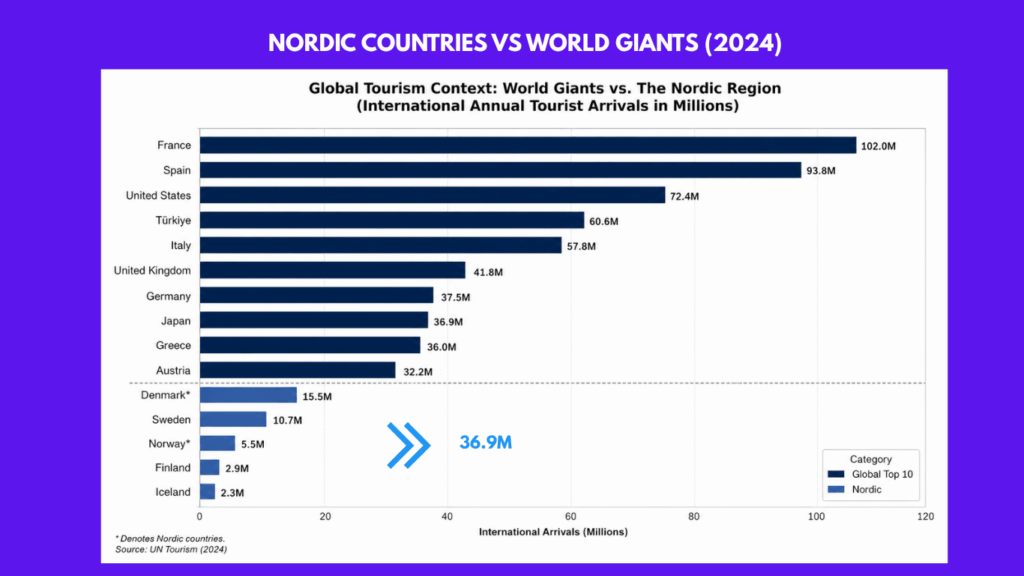
While Denmark leads the Nordics in pure arrivals due to its immediate land border connectivity with Germany, it still represents a fraction of the traffic seen by Mediterranean giants. As the data demonstrates, France and Spain alone absorb nearly 200 million arrivals annually.
In contrast, the entire Nordic region combined captures roughly 37 million international arrivals.
The Nordic region thrives in a specialised ecosystem that rewards intentional, design-conscious, and independent travellers.
The future belongs to “Deep travellers”, those that seek deeper meaning, connection, authenticity, and transformative experiences in their travels.
And that’s where the Nordic Countries hold their gold value 🧡
LinkedIn original post: https://www.linkedin.com/posts/angels-bosch